The Unsung Hero: Kuriakose Elias Chavara and His Contributions to Kerala's Literacy Rate
- Jasmine Saini
- Jul 14, 2022
- 4 min read

A person behind the maximum literacy rate in Kerala (India)

St. Joseph’s Monastery Church, Mannanam is all about the father, Kuriakose Elias Chavara, a man who contributed his whole life in social service. He was born in Kainakary, near Alappuzha, Kerala on February 10, 1805. His family belonged to the ancient Christians community known as Saint Thomas Christians. He was baptized on the 8th day in Chennankari Parish Church, Alppuzhua. He got his early education from the local village and studied language and elementary sciences.
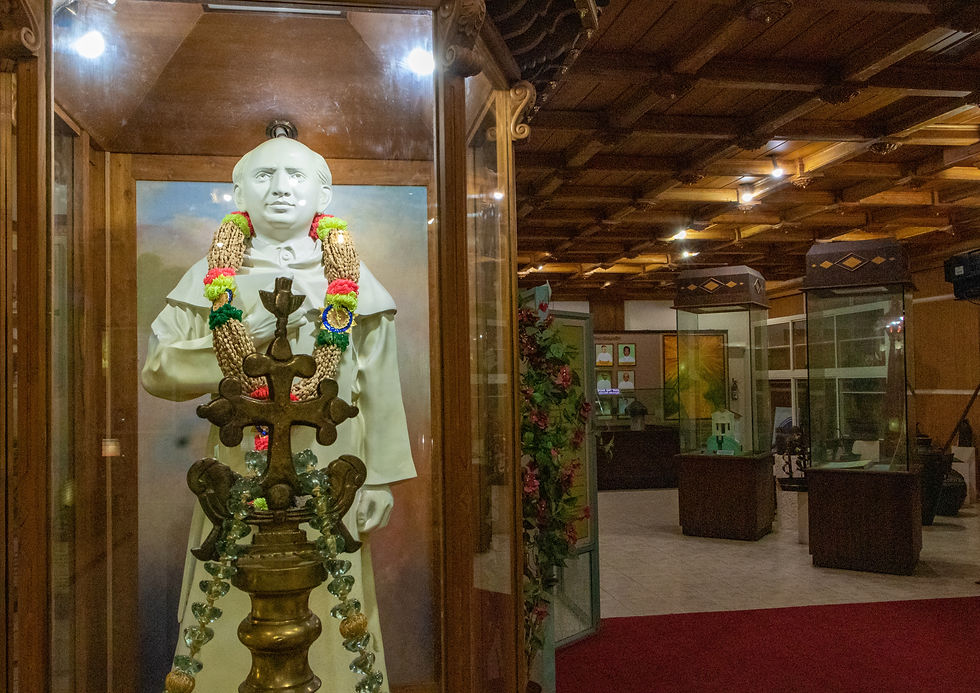
Kuriakose is an unsung hero behind the maximum literacy rate of Kerala, India. He was an educator, writer and a social reformer. He was the one who started schools in the communities of Mannanam and Arpookara and midday meals in Kerala. The midday meal was his original idea. According to him, schools would only be successful if the poor students were fed properly. He was of the view that to learn; one should have his stomach full. The midday meal practice is continued till now in government schools.

He has also written several books with unique spiritual vision in verse as well as in pros. Most of his writings are handwritten by himself in Malayalam language.
St. Joseph’s Monastery church is situated in town Mannanam in Kottayam district, a place full of exotic beauty of the hills. On May 22, 1831, Father Kuriakose Elias Chavara, with the help of his three friends; Father Thomas palackal, Father Thomas porukara and Brother Jacob kaniyanthara in the presence of the Bishop Maurelinus Stabilini, laid the foundation by establishing a crucifix for the new beginning of monastery.

The peaceful and serene environment of the Monastery is ideal to meditate. The simple yet beautiful structure of the Church mixes well with the natural surroundings of the hill, blessed with green trees. Interior beauty of the Chapel effuses aesthetic ebullience.

St. Joseph’s Monastery is famous for its historical importance and for the relics of St. Chavara. The old items related to Chavara are carefully kept in the church. The room, where St. Chavara lived for 32 years, is situated on the northern side of the church. All of the Chavara's belongings like chair, cot, wooden box etc. are present in this room.

The Chavara art museum is within the range of 50m of Church and exhibits good canvas paintings which depicts the life journey of Father Kurialose Elias Chavara. Old utensils, vases, wooden ploughs used by him in his paddy fields, country boat, bullock cart, books and the model miniature of his house are also showcased in this museum.

In 1846, Chavara got success in establishing the printing press in Mannanam, Kerala. Although, it was the third such press, but it was purchased without any foreign help. He started printing a religious newspaper 'Nasrani Deepika' in this press, which is one of the oldest continually publishing newspaper in India. This paper is published in Malayalam, the local language of Kerala, which played a vital role to increase the literary culture by establishing a routine for reading in the region.
He had also started the trend of contributing one handful of rice to the poor and the needy people. This charity practise is known as Pidiyari, which was also a great support to the midday meal popularized by Chavara in schools. This scheme was carried out in the following way: Contributor would daily set aside one handful of rice in a separate pot. During weekends, the collected rice would be brought to the Church, where that was used to feed the poor and students in the midday meal. It was the duty of 'Unnimishihayude Dharma Sabha', an organization formed by Kuriakose Chavara, to look after the collection of Pidiyari.

Kurialose Elias Chavara also founded the first religious congregation for women in Kerala. It was his deep desire, and after several attempts, with the co-operation of Italy Missionary (Fr. Leopold Beccaro), the first Carmetile convent for women was inaugurated at Koonamavu, under the name of ‘Third Order of Discalced’. The motive of starting this congregation was to empower the women and to fulfil their religious needs.

At the age of 66, when Kurialose Elias Chavara died on January 3, 1871, at Koonammavu, he was buried by his followers in St. Philomena’s Forance Church. His holy remains were moved to St. Joseph’s Monastery Church with the permission of the Vice General of Verappuzha, Rev. Fr Philiposus. His mortal remains are still preserved in this church. Thousands of devotees visit this church every day to pay homage to the saint and lay their heads on the tomb.

Father chavara was a missionary as well as a visionary saint who left no area of human endeavour where he has not worked to his best. The credit of the first catholic indigenous religion congregation of men (CMI), the first printing press, the first Sanskrit school, the first congregation for women (CMC) in Kerala goes only to him. A famous saying of father Chavara is “In every hardship and pain in this world, a valley of tears, the sweetest consolation is to live in a family with peace, love and order”.


Comments